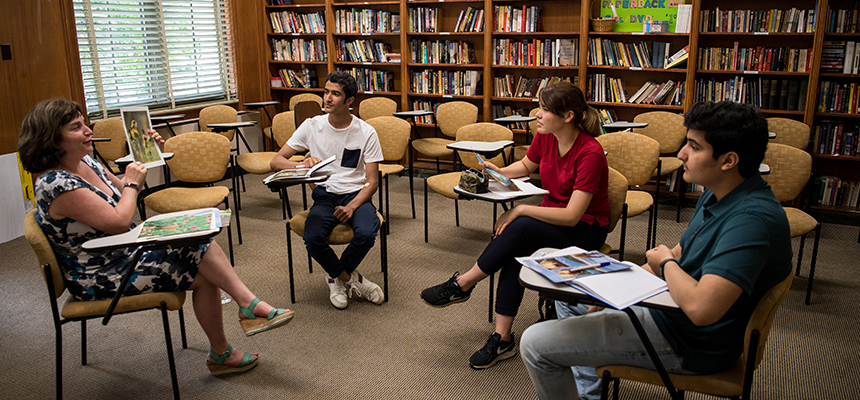
The Master of Arts in TESOL (MATESOL) program addresses the need for more teachers of English as a second or modern world language—both in the United States and abroad.
Program Options
Notre Dame offers several options to study TESOL at the graduate level:
Non-Certified Individuals
- MA in TESOL for non-teachers who want either initial K-12 certification or to teach in a post-secondary environment
- MA in TESOL for Peace Corps volunteers who have taught English abroad as part of their service
- Post-Baccalaureate Certificate for certified and non-certified individuals who hold a bachelor’s degree
Certified Teachers
- MA in Leadership in Teaching: ESOL for experienced teachers who already hold a K-12 state certification (in ESOL or another area)
- Post-Baccalaureate Certificates for Teachers – Notre Dame of Maryland University for certified and non-certified individuals who hold a bachelor’s degree
- Post-Master’s Certification for certified teachers who already hold a master’s degree
MA in TESOL Concentrations
- PreK-12
- Teach ESOL in U.S. public schools, grades PreK-12.
- 39 Credit Program
- Includes a One Year Internship in a Maryland Public School
- ePortfolio, edTPA portfolio and Praxis exams required for Maryland PreK-12 ESOL Certification
Post-Secondary
Teach ESOL in post-secondary education, in addition to non-traditional educational settings, such as adult education ESL programs, or EFL (English as a Foreign Language) programs abroad.
- 33 Credit Program
- Includes a Practicum Experience
Peace Corps | Coverdell Fellowship Program
Returned Peace Corps volunteers who taught English abroad may continue their studies in the ESOL field in our MA in TESOL program. Students in this program will earn a master’s degree and Maryland teaching certification in ESOL grades PreK-12.
Learn more about our partnership including credit for experience, employment, and job/internship placement.
What to Expect Studying at Notre Dame of Maryland University
With award-winning teacher certification programs nationally recognized by the Council for the Accreditation of Educator Preparation (CAEP), you can expect to benefit from small class sizes, expert faculty, and practical field experiences.
Flexible Class Schedules
We accept new students each enrollment term: fall, winter, spring and summer.
Choose How to Take Classes
- Weekday Evenings
- Fully Online
Internship Opportunities
Internship opportunities depend on the chosen track:
- PreK-12: Local public school
- Post-secondary: Teaching practicum on campus in our English Language Institute
Grants & Scholarships
English as a Second Language is considered a critical shortage area in Maryland and nationwide.
You may be eligible for special grants offered to train additional teachers to meet the growing demand for ESOL educators.
- The TEACH grant is a federal grant available to students who agree to teach for four years in a school that serves students from low-income families following graduation.
- The Workforce Shortage Grant is a State of Maryland grant available to students who agree to teach in a Maryland school.
Concentrations and Outcomes
Required Courses
EDU 508 – Issues in TESOL (3)
EDU 519 – Human Development and Learning (3)
EDU 543 – Reading, Analyzing and Interpreting Educational Research (3) OR EDU – 604 Analytic, Reflective Research Seminar (3)
EDU 545 – Principles of Linguistics (3)
EDU 546 – Methods and Materials for TESOL (3)
EDU 547 – Assessing Second Language Acquisition (3)
EDU 548 – Language Learning (3)
EDU 556 – Technology for Instruction and Management (3)
EDU 586 – Techniques of Teaching Reading & Writing to English Language Learners (3)
EDU 596 – English Grammar for ESL Teachers (3)
SPE 526 – Special Education for the Classroom Teacher (3)
Internship Requirements
EDU – 611 Internship (6)
- Part-time in the fall semester, full-time in the spring semester
- Conducted under the supervision of a mentor teacher and a university supervisor
- Students who are already teaching ESOL full-time in a local school system may use their teaching job for the internship
Required Courses
EDU 508 – Issues in TESOL (3)
EDU 543 – Reading, Analyzing and Interpreting Educational Research (3)
EDU 545 – Principles of Linguistics (3)
EDU 546 – Methods and Materials for TESOL (3)
EDU 547 – Assessing Second Language Acquisition (3)
EDU 548 – Language Learning (3)
EDU 556 – Technology for Instruction and Management (3)
EDU 586 – Teaching Reading and Writing to English Language Learners (3)
EDU 596 – English Grammar for ESL Teachers (3)
EDU 697 – Language and Intercultural Communication for Changing Populations
Practicum
EDU 595 – Teaching Practicum (3)
Note: *If candidates obtain 150 documented hours of teaching adults in the community, they may choose an EDU 500 elective to complete the 33-credit program.
Required Courses
EDU 508 – Issues in TESOL
EDU 545 – Principles of Linguistics
EDU 546 – Methods and Materials for TESOL
EDU 548 – Language Learning
Student Outcomes
As a student in this program, you will be able to:
- Use the knowledge of students to inform your teaching practice.
- Plan assessments to monitor and support student learning.
- Demonstrate skill in checking for student understanding and using feedback to assess.
- Utilize formative and summative assessments to inform your instructional practice.
- Deepen student learning by providing scaffolded opportunities for higher level, deeper learning.
Program Outcomes
At the completion of the program, you will be able to:
- Pass all national testing requirements, as applicable, achieving a 100% pass rate for NDMU.
- Enhance career and professional development opportunities for employment pathways in the profession, e.g., elementary or secondary education teacher, highly qualified with a dual or triple certification, professional developer, preparation for teaching in higher education, etc.
- Document an ability to design a thorough lesson plan that addresses the needs of all students and which provides for both formative and summative measurable student outcomes.
- Utilize classroom management skills to effectively engage students and maximize learning opportunities for all students.