Students Contribute Genomic Research Uncovering Unknown Microorganisms in National Soil Microbiome Study
BioDIGS Photos
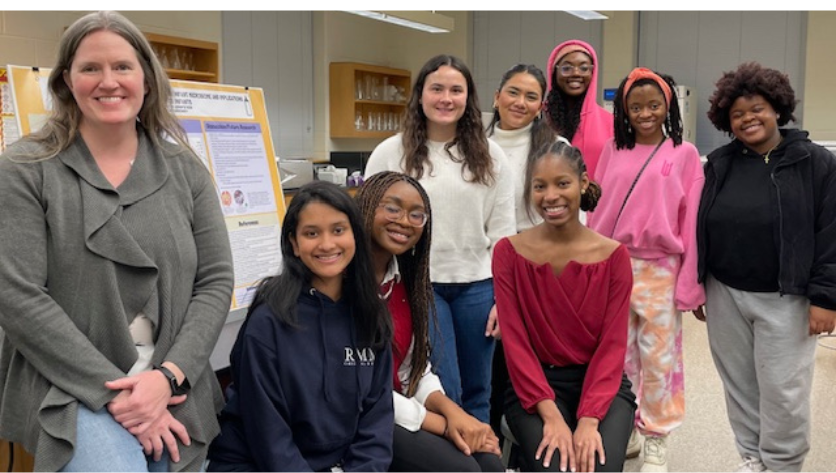
BALTIMORE, Md. – Eleven undergraduate students and two faculty at Notre Dame of Maryland University (NDMU) are playing a hands-on role in one of the largest soil microbiome studies ever attempted through the BioDiversity and Informatics for Genomics Scholars (BioDIGS) Project.
NDMU faculty and students from the Biology Department are contributing directly to this nationwide research initiative that spans across 40 sites with more than 150 team members in the United States run by the BioDIGS Consortium. NDMU faculty Dr. Jennifer Kerr and Dr. Sayumi York lead a team of student researchers: Jefferson Da Silva ’27, Grace D. Ekalle ‘26, Namoi Ewhe’27, Rachel Johnson ‘26, Kritika Kc ’25, Disomi Okie ‘26, Tolulope Olowookorun ‘27, Nisttha Ray ’26, Ariana Rodriguez ‘27, Loraye Smith ‘25, and Nwanneka Udolisa ’25. The NDMU faculty and students were co-authors of a December 2025 article on the BioDIGS research in Nature Genetics, a leading peer-reviewed journal for high-impact research on how genetics impact human disease, biological function, and evolution.
The team’s first goal is to recover soil microbial genomes and catalog soil biodiversity. Scientists studying soil bacteria use advanced methods like DNA sequencing instead of growing cultures in a lab because an estimated 99 percent of soil microorganisms have never been genetically characterized – a vast biological unknown often referred to as microbial “dark matter.”
What sets BioDIGS apart, according to NDMU Professor Jennifer Kerr, is not only the scale of the science, but who is involved in doing it. “This project is bringing together undergraduate scientists, researchers, and educators from across the country in what is potentially the largest project ever done at this level,” Dr. Kerr said. “Undergraduates are typically not involved in research on this scale—but BioDIGS includes them from the very beginning and all the way through.”
At NDMU, students are participating in authentic research experiences that start with collecting soil samples from a wide range of environments, including urban spaces, parks, campuses, and rural landscapes. Once processed and sequenced, these samples produce massive amounts of genomic data that reveal the diversity and hint at the functions of microbial communities within the soil, contributing to analyses that will ultimately be made publicly available to researchers around the world.
The students use these data to assemble microbial genomes, catalog previously uncharacterized microorganisms, analyze how microbial diversity and composition varies across samples and correlates with different environmental conditions, and identify key genes of interest.
Soil microorganisms play essential roles in ecosystems in ways scientists are still working to understand. They drive critical processes such as carbon and nitrogen cycling, and interact with plants, fungi, and animals. Soil is also a known reservoir for antibiotic resistance genes, making it a key focus for researchers studying public health and environmental change. Through BioDIGS, students explore how microbial communities vary in response to environmental factors such as land use, pollution, and heavy metal contamination. These analyses will help researchers better understand how human activity shapes soil ecosystems—and how changes underground may signal broader environmental or health risks.
“Students aren’t just learning techniques,” Dr. Kerr said. “They’re working with real data to ask meaningful questions about how soil ecosystems function and why that matters.”
Although initial grant funding for BioDIGS has concluded, the work continues. The project’s data will be analyzed for years to come, and many of the tools used are freely available, allowing students to remain engaged with the research.
At NDMU, Dr. Kerr plans to continue involving students in related bioinformatics and data science projects, building on the foundation established through BioDIGS. As researchers work to illuminate the soil’s hidden biodiversity, NDMU students are helping uncover what has long remained unseen demonstrating that meaningful scientific discovery can begin at the undergraduate level—one soil sample at a time.
“This is just the beginning,” she said. “Students are gaining skills, contributing to national research efforts, and seeing themselves as scientists who can push the field forward.”
Established in 1895, Notre Dame of Maryland University (NDMU) is a private, Catholic institution in Baltimore, Maryland, with the mission to educate leaders to transform the world. Notre Dame has been named one of the best "Regional Universities North" by U.S. News & World Report.