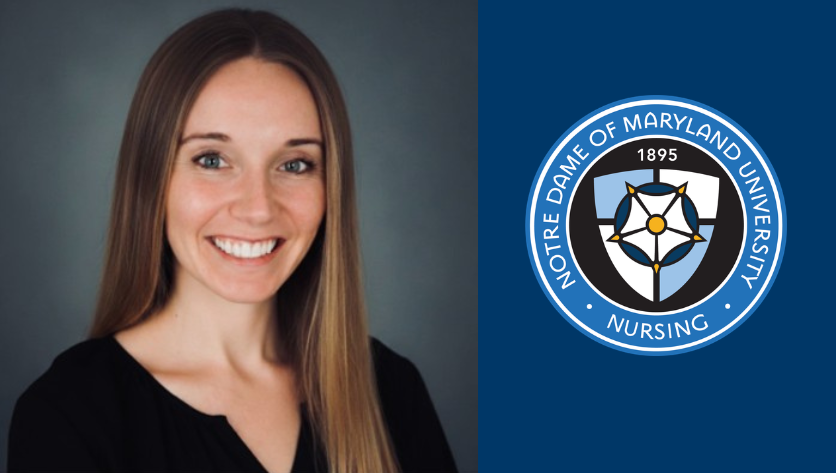
Faculty Spotlight: Dr. Lyndsay Wright ’19, M’22
BALTIMORE, Md. – For Dr. Lyndsay Wright ’19, M’22, she doesn’t just want her students to perform well on their next exam. She also cares about how well they sleep. “How many nursing students get 8 hours of sleep? Not many,” she said. “As their clinical instructor, I want them to prioritize their sleep. Whether it is sleep, diet, or exercise, I want to inspire them to take care of themselves.”
The assistant professor in Notre Dame of Maryland University’s School of Nursing tries to model how to prioritize your health and encourages her students to do the same for their patients. “As a professional nurse, you have a duty to yourself – the same duty that you owe to others, you owe to yourself,” she said.
Dr. Wright takes her passion for healthy living into the classroom. In 2025, she earned a Doctor of Nursing Practice, with a concentration in lifestyle medicine, from Southern Adventist University. Her doctoral research, focused on how to infuse lifestyle medicine into the nursing curriculum, not only helps students adopt self-care practices, but it helps them see every patient as a “whole person when they provide care,” she said.
Learn more about how Dr. Wright infuses lifestyle medicine into her teaching and how it benefits her students:
What is lifestyle medicine, and how do you incorporate it into your nursing courses?
Lifestyle medicine is a medical specialty that prioritizes therapeutic lifestyle interventions to prevent, treat, and sometimes even reverse lifestyle-related chronic disease, which is the majority of the burden disease we are seeing right now. It addresses behavior and overall environmental modifications to promote the agency of the patient, helping them make changes to preserve and improve their health.
I try to integrate it in every classroom conversation. Every time we talk about a case study, and we are looking at a patient scenario, I ask, ‘How could we attend to this person's spiritual health, their diet, or their physical activity level? How can we support them?’ I can tell from my students’ assignments that those lessons are making a difference when they are making their care plans. Or when I overhear the students during clinical talking to a patient, asking, ‘What brings you joy?’ or ‘What would inspire you to become more physically active or eat more fruits and vegetables?’
I can see many of the students applying it to their own lives as well. One of our values in the School of Nursing is self-care. How better to live out self-care than through modalities like lifestyle medicine, which look at the whole person?
Where does your passion for lifestyle medicine and nursing education come from?
My passion started when I was young. I saw my mom work really, really hard as a single parent, being there for me, juggling the demands of owning a home, getting me to soccer practice, but not prioritizing her own health. That led her to become chronically ill and have quite a few lifestyle-related medical conditions. While I was in nursing school at Notre Dame, my mom was diagnosed with multiple chronic health conditions, including kidney disease, high blood pressure, and elevated cholesterol. I immediately went on a hunt to figure out what we could do together to improve her health and prevent future complications. We basically emptied out all our cabinets, and I practically forced her to quit smoking. We prioritized our health, getting physically active, and eating more fruits and vegetables. That was where the pursuit of lifestyle medicine started. The miracle is that my mom no longer has kidney disease, with normal blood pressure and cholesterol levels, after strict adherence to her medical regimen and intensive lifestyle changes. Nearly 10 years later, she is no longer chronically ill from a clinical perspective and continues to live a healthier lifestyle.
After I graduated from Notre Dame, I realized that as a bedside nurse, I could only affect maybe five to seven patients in one shift at the hospital. That wasn't enough for me. I figured that maybe nursing education would be a way to reach more people. I could help students to learn this way of nursing – to plant those seeds of behavior change for their patients. And in turn, not only would I affect students by allowing them to commit to better caring for themselves and their family members, but then that would hopefully trickle down to their patients. That was my impetus for going into nursing education.
You have decided to continue working as a professional nurse even while teaching at NDMU. Why is it important for you to continue your clinical practice?
I just love my patient population [at MedStar Franklin Square Medical Center]. In my unit, I work primarily with stroke patients. It’s my home. I am going on my eighth year there. I just love the team. Everyone in that hospital is my family. I feel like I am still able to engage with my community because it is a community hospital where we often see the same patients. I also still love to be at the bedside. Bringing students there really makes me happy as well.
How did your experience as an NDMU student impact the educator you are today?
I can relate to the student experience here. There is such a diverse population at Notre Dame, and many of our students come from non-traditional backgrounds. That was the case for me as a first-generation college student. I did not know what to expect from going to college. I picked Notre Dame because it felt like home.
I see a lot of myself in many of my students who have picked Notre Dame for similar reasons. Knowing just how committed Notre Dame is to personal transformation, I strive to work toward being the best educator to help my students transform. College should change you in the best way – that's what it did for me. I want my students to have that same transformative experience, so they can go out into the world and be the best version of themselves.
Established in 1895, Notre Dame of Maryland University (NDMU) is a private, Catholic institution in Baltimore, Maryland, with the mission to educate leaders to transform the world. Notre Dame has been named one of the best "Regional Universities North" by U.S. News & World Report.