Pharmaceutical Science Professor Champions Student Research Experience at NDMU
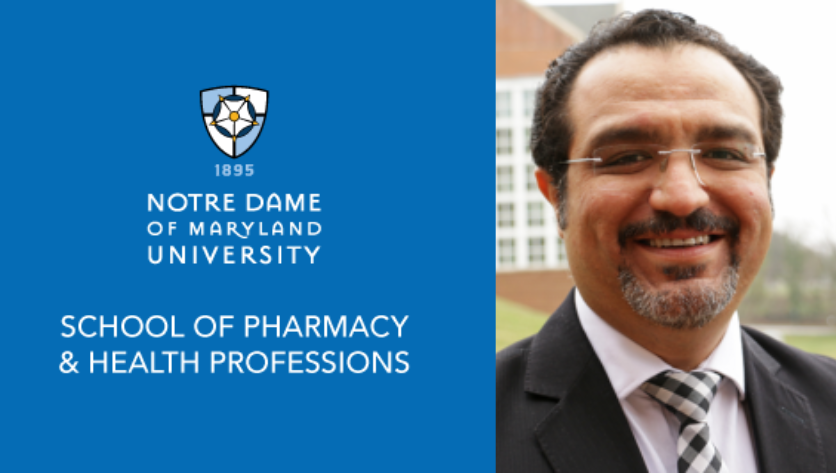
BALTIMORE, Md. – A prolific researcher in pharmaceutical analysis with more than 50 articles published, Notre Dame of Maryland University professor Dr. Ahmed M. Abdel Megied Ali is a champion for hands-on student research. Since joining the faculty of the School of Pharmacy & Health Professions in February 2022, he has involved his students in groundbreaking research, studying medications to test their quality, purity, and efficacy in the human body.
Dr. Ali works with teams of scientists from institutions around the world to shed light on how and why particular groups of medications work effectively. He is part of a research team that published a new landmark study on an emerging class of drugs called Oligonucleotide therapeutics – a type of gene therapy – in the Journal of Chromatography A, a globally renowned publication for cutting-edge research. Led by Dr. Jace W. Jones from the University of Maryland School of Pharmacy, this study explores analytical methods to identify and quantify the specific mix of compounds needed to develop, evaluate, and approve effective and safe Oligonucleotide therapeutics. The study grew out of a three-year collaboration between NDMU, the University of Maryland School of Pharmacy, the U.S. Food and Drug Administration (FDA), and the National Institute of Standards and Technology (NIST).
Additionally, in spring 2025, Dr. Ali secured an NDMU faculty research grant for the School of Pharmacy & Health Professions to purchase a Liquid Chromatography-Tandem Mass Spectrometry (LC-MS/MS) instrument, which scientists use to analyze the components of complex substances. The LC-MS/MS has wide applications across multiple disciplines, and several NDMU departments and faculty researchers can use it.
Learn more about Dr. Ali’s research and how students in the new Master of Science in pharmaceutical sciences program can benefit from the new LC-MS/MS:
What are your research interests and background?
My research is typically in pharmaceutical analysis of small molecule- and large biomolecule-marketed drugs [complex medications derived from living organisms or their components]. My work uses sophisticated tools and methods to learn how drugs function in our bodies and the concentration of drugs needed for them to be effective. I collaborate with scientists from around the world on research that typically takes place in the preclinical phase before the approval of clinical studies on the drugs. My research explores questions like, ‘If you are buying a Tylenol, how can you be sure that you are accurately taking 500 milligrams of acetaminophen per tablet?’
I received my Ph.D. between Germany and Egypt. Before joining NDMU, I was a postdoc at the University of Maryland School of Pharmacy Mass Spectrometry Center. Before that, I was in Germany doing my postdoc research stay at the Technical University Braunschweig. In the meantime, I was doing a lot of consultation in Egypt and Middle East to ensure that bioequivalent drugs, commonly known as generic drugs, have the same efficacy as brand name medications. Since my hiring at NDMU, I have been committed to advancing my research and involving students.
Can you describe the research article you recently published in collaboration with the University of Maryland School of Pharmacy, the FDA, and NIST?
The research article, published in the Journal of Chromatography A, is focused on Oligonucleotide therapeutics, which are drugs designed to target specific genetic defects by modifying, adding to, or replacing genes that cause disease. Oligonucleotide therapeutics are proven to treat and cure genetic diseases. For the therapeutics to function effectively, strands of DNA or RNA must be chemically modified. One major challenge of developing these drugs is protecting the Oligonucleotides from being attacked by the body’s natural defense mechanisms, which readily recognize and break down foreign invaders. Therefore, these drugs are engineered to closely mimic natural DNA or RNA, so they can be recognized and utilized in the body on a cellular level. Another critical challenge is achieving optimal drug concentration within target cells to ensure the therapeutics are both effective and safe.
The findings in this study will support drug development, evaluation, and regulatory approval of generic Oligonucleotide therapeutics. Right now, there are 21 brand name Oligonucleotide medications on the market, so our research will help inform drug regulators at the FDA of the methods needed to evaluate the efficacy and safety of a new generic drug before it can go to market. Dr. Jones from the University of Maryland School of Pharmacy is the principal investigator on this project and leads the research team.
This study is my first time publishing an article in the Journal of Chromatography A, which is considered the cornerstone pharmaceutical analysis journal.
How will you and other NDMU faculty use the new LC-MS/MS instrument?
The LC-MS/MS instrument serves as a powerful analytical tool, much like an enhanced eye that allows us to see and understand complex chemical processes. This instrument is very sensitive in measuring the molecular weight of drugs. Typically, measuring drugs in biological fluids, such as blood and urine, is challenging due to their extremely low concentrations; therefore, a sophisticated instrument like LC-MS/MS is essential to accurately identify and quantify trace concentrations of the drugs. Importantly, LC-MS/MS can generate reliable results within minutes.
Right now, I am collaborating with Dr. Jennifer Kerr, the chair of Biology Department at NDMU, on a grant-funded project to identify trace amounts of antibiotics found in our food and meat, like chicken. She is providing samples to test, and then we collaborate on developing the statistical analysis. Dr. Kerr involves undergraduates in the Biology Department in her research. We want to encourage undergraduates to use such an instrument in research, so they can engage with faculty in poster presentations and publications. Those hands-on experiences will accelerate the students’ career advancement.
How will the students in the Master of Science in pharmaceutical sciences program benefit from working alongside you and other faculty using the LC-MS/MS?
Since my hiring in 2022, I have acted on a detailed roadmap to expand NDMU’s graduate offerings in pharmaceutical sciences. Students in the new Master of Science in pharmaceutical sciences program can complete the degree in two years, focusing on a track in one of three areas: pharmaceutics, medicinal chemistry, or pharmacology. In their final semester, there is a capstone research project where students in all three tracks can benefit from using the LC-MS/MS instrument.
Having that kind of hands-on research experience as a master’s candidate will give our graduates an advantage when they apply for positions in the highly competitive pharmaceutical sciences industry and in regulatory agencies later in their career. The master’s candidate who graduates with hands-on experience can be placed on a research project from the second day of work. That research experience will distinguish NDMU graduates from others.
What are your plans for future research?
Looking ahead, my future research will focus on expanding student-centered, hands-on projects that provide practical experience in the bioanalysis of emerging therapeutic modalities. A key objective is to integrate Master of Science in pharmaceutical sciences students directly into research projects involving advanced analytical techniques, particularly LC-MS/MS-based bioanalysis.
Planned projects will emphasize the development and validation of bioanalytical methods for new modalities, including complex drug delivery systems. Through these projects, students will gain hands-on experience in sample preparation, chromatographic method development, mass spectrometric analysis, data interpretation, and regulatory-aligned documentation.
These research activities will be incorporated into the capstone research experience in the final semester, allowing students from the pharmaceutics, medicinal chemistry, and pharmacology tracks to collaborate on interdisciplinary projects. This approach will strengthen their technical skill sets, deepen their understanding of translational pharmaceutical research, and better prepare them for careers in industry, regulatory science, or doctoral training.
Established in 1895, Notre Dame of Maryland University (NDMU) is a private, Catholic institution in Baltimore, Maryland, with the mission to educate leaders to transform the world. Notre Dame has been named one of the best “Regional Universities North” by U.S. News & World Report.