
The gap in our healthcare system isn’t about bad providers. It’s about a missing bridge.
By Marybeth Missenda MS RPh. Program Director for Integrative Health Studies at NDMU
4/30/26
Your doctor recommends physical therapy and a prescription for your chronic back pain. Your yoga therapist suggests a course of treatment based on a completely different understanding of what’s happening in your body. Your nutritionist has a third perspective—something about inflammation and gut health. Each one is credentialed, experienced, and genuinely trying to help.
But nobody’s talking to each other.
You’re the one sitting in the middle, holding three care plans that don’t connect, wondering whose advice to follow—or whether you’re supposed to do all three at once and hope for the best. If this sounds familiar, you’re not alone. Millions of Americans use both conventional and complementary health approaches according to the National Health Interview Survey in 2022. And most of the time, the providers on either side have no framework for collaborating with each other.
A Gap Nobody Trained Us to Bridge
This isn’t a failure of any single provider. It’s a structural problem. Our healthcare system trains people in separate worlds. Physicians learn within a conventional medicine framework. yoga therapists train within yoga principles and practices. Nutritionists may work from a functional, clinical, or lifestyle medicine perspective. Health and wellness coaches learn motivational interviewing and behavior change. Each world has its own language, its own evidence standards, and its own assumptions about what health means and how healing works.
The result? When a patient seeks care from more than one practice—which the National Health Interview Survey from 2022 reports that 36.7% of American adults do—there’s often no one in the room who can translate between them. The physician may dismiss the yoga therapist’s approach. The yoga therapist may feel the physician doesn’t see the whole person. And the patient is left navigating a system that wasn’t designed to hold more than one perspective at a time.
What If Someone Could Connect the Dots?
That’s the promise of integrative health—and it’s different from what most people think when they hear the term.
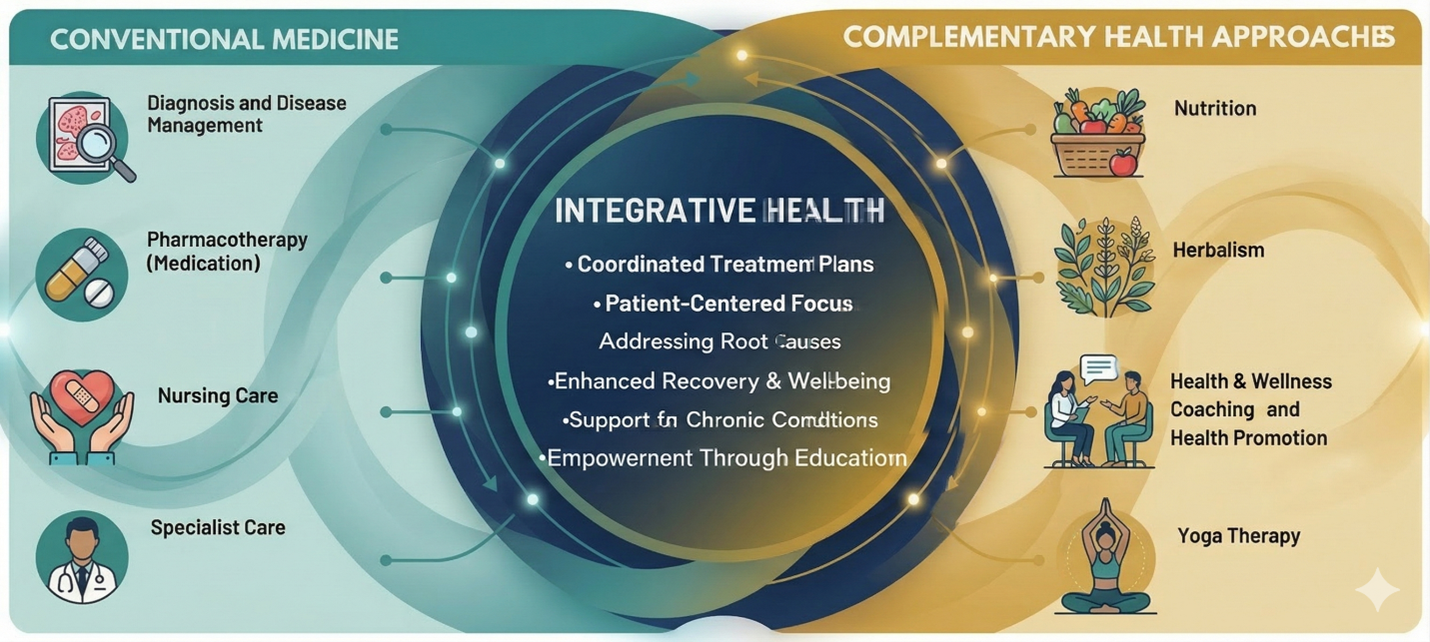
Integrative health isn’t about choosing alternative medicine over conventional medicine, or vice versa. It isn’t simply adding a yoga class to a hospital’s menu of services. And it’s not the same as lifestyle medicine, which according to the American College of Lifestyle Medicine focuses on six evidence-based pillars (nutrition, exercise, sleep, stress management, social connection, and substance avoidance) that operate entirely within a conventional medicine framework.
Integrative health is broader. It reaches beyond the hospital and clinic walls. It considers the whole person —body, mind, and spirit—and it takes seriously the idea that multiple healing traditions each carry knowledge worth understanding. It asks not which provider has the right answer, but how we bring their different perspectives together in service of the patient. Part of what makes integrative health confusing is that many programs and organizations use the term without clearly defining what they mean by it. At NDMU’s School of Integrative Health, we’ve been deliberate about that:
|
“Notre Dame of Maryland University's School of Integrative Health (NDMU SOIH) promotes a holistic approach to health and well-being. We consider the physical, emotional, social, and spiritual domains of health and wellness. We also consider a range of contributing factors including the environment, personal behaviors, and genetics. Our educational and clinical practices are grounded in a whole-person and relationship-centered perspective that supports collaboration between the patient and the healthcare team.” — Notre Dame of Maryland University, School of Integrative Health |
The collaboration is key! It bridges between the self-care and clinical care to fully support the whole person. Each member of the team, including the patient! brings insights and evidence to inform the best possible care. With this kind of definitional clarity, patients and practitioners have greater clarity about this healthcare model.
From 1994 to Today: Why This Global Movement Matters
Integrative health isn’t new. Dr. Andrew Weil established the country’s first academic integrative medicine program at the University of Arizona in 1994, built on the premise that biomedical, complementary, and traditional approaches each hold valuable knowledge. By the late 1990s, academic health centers at Duke, Harvard, and Stanford had formed a consortium around this vision. The 2017 Berlin Agreement which gathered 13 different nations made it a global movement, calling for care that “draws on biomedical, complementary and traditional practices and respects multiple philosophies” (page 1 Introduction)
What’s newer is the recognition that this work requires dedicated training. It’s not enough to be an excellent nurse or a skilled yoga therapist. The healthcare system needs professionals who can move between paradigms—who understand why the physician and the yoga therapist see the same patient differently, and who can facilitate a conversation that honors both perspectives without requiring either to abandon their framework.
Building the Bridge
That’s what we do at NDMU’s School of Integrative Health. Our Integrative Health Studies program has been developing bridge-builders since 2020—practitioners who can evaluate evidence across traditions, navigate the real conflicts that arise when different health paradigms meet in a clinical setting, and advocate for care that centers the whole person.
Since our merger with Notre Dame of Maryland University in Fall 2025, our students have opportunities to learn alongside future nurses, pharmacists, physician assistants, occupational therapists and art therapists as well as Ayurvedic Wellness practitioners, herbalist, nutritionists, health and wellness coaches, health promotion practitioners, integrative health studies specialists, and yoga therapist. The interprofessional collaboration that integrative health demands isn’t something we lecture about—it’s something our students discuss and practice with others.
The confusion was never about integrative health. It was about a healthcare system that trained providers in silos and hoped patients would figure out the rest. Integrative health is what clarity looks like — and we're training the workforce to deliver it.
Our patients are holding three different care plans from three different providers… They deserve a healthcare system where someone connects the dots. We’re training the people who will.
Sources
- National Center for Complementary and Integrative Health. nccih.nih.gov/research/national-health-interview-survey-2022
- Andrew Weil Center for Integrative Medicine: About Us: Andrew Weil Center for Integrative Medicine
- The Berline Agreement. The Berlin Agreement: Self-Responsibility and Social Action in Practicing and Fostering Integrative Medicine and Health Globally.
- American College of Lifestyle Medicine : About us Lifestyle Medicine
- Maryland Independent College and University Association. Notre Dame of Maryland University Becomes First Comprehensive University with a School of Integrative Health After Merger of Maryland University of Integrative Health | micua.org
Disclaimer: this post is part of a series of posts about integrative health by NDMU’s School of Integrative Health.